
Curly Styles | Aveda Nutriplenish Line
Curly Hair, Finally Fed
How to identify your curl pattern, build a routine around it, and get the most out of Aveda's Nutriplenish line — the system designed specifically for dry, thirsty curls.
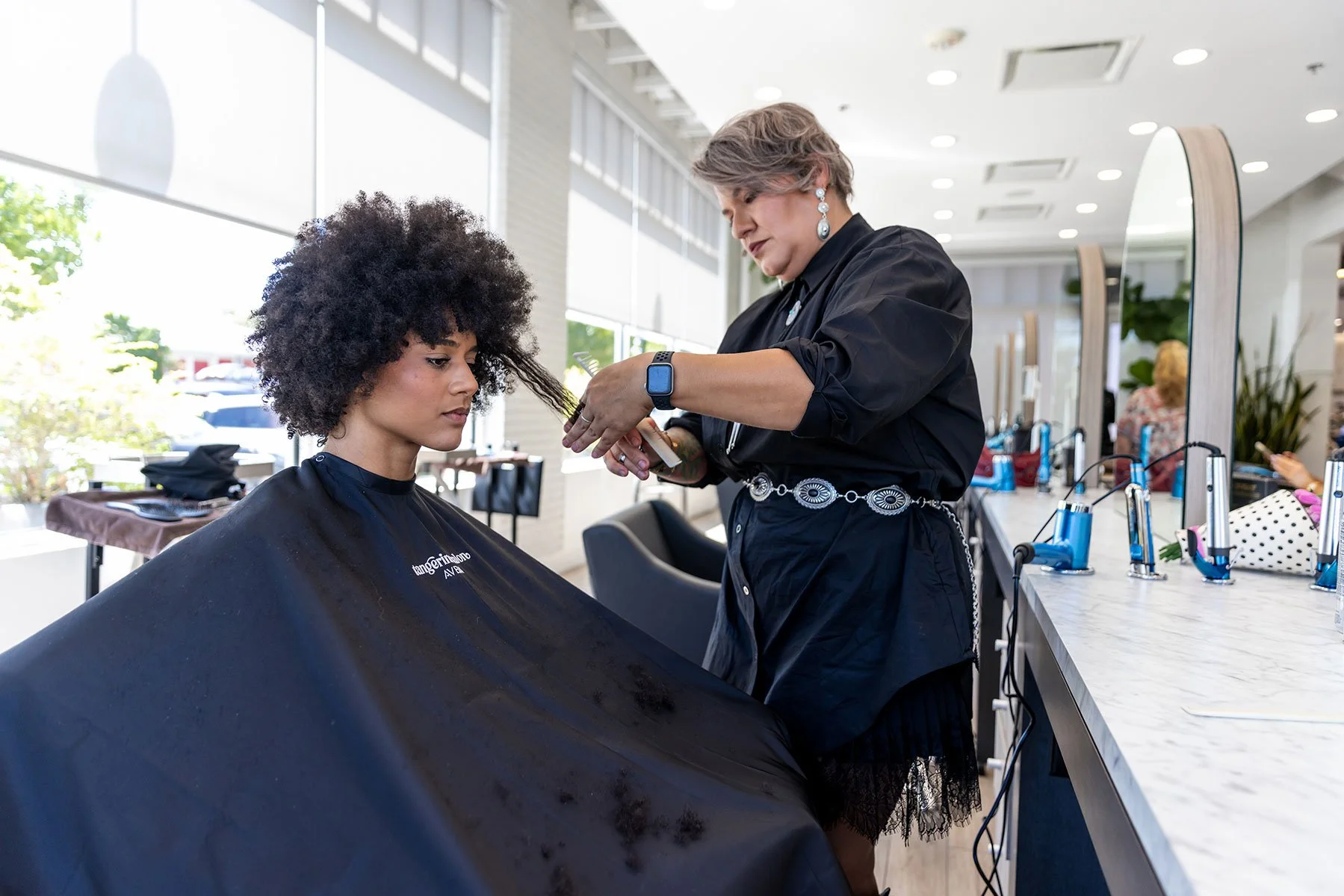
Curly hair is not difficult hair. It is different hair — and it responds to a completely different set of rules than straight or wavy hair does. The products that work beautifully on your friend with fine, straight hair will fight your curls. The wash-and-go that takes her fifteen minutes will take you an hour if you haven't built the right foundation. And the "frizz" that curly-haired clients describe as their biggest problem is almost always a symptom of one thing: moisture loss.
At Tangerine Salon, our Aveda-trained stylists work with every curl pattern across all five Dallas-Fort Worth locations. We reach for Aveda's Nutriplenish™ line as the foundation of nearly every curly hair routine we build — because it was created specifically to address what curly hair actually needs. This guide explains the system, who it's for, and how to get the most out of it from wash day through your next salon visit.
Understanding Your Curl Pattern
Before products, before technique, before anything else — you need to know what you're working with. The standard curl typing system (2A through 4C) gives you a starting vocabulary, though most heads of hair have more than one curl type at once. Your stylist at any of our Dallas, Coppell, Frisco, Allen, or Highland Village locations can help you map your pattern and build a routine accordingly.
S-shaped waves that lie relatively flat at the root before forming a loose bend from mid-length to ends. Type 2A is barely-there wave; 2C is a defined, almost-curly wave with more frizz potential. Wavy hair tends to be fine-to-medium in texture and can go limp under heavy product.
Rec: Nutriplenish™ Light Moisture — won't weigh waves downDefined spirals and ringlets ranging from loose barrel curls (3A) to tight, springy coils (3C). Type 3 curls have more volume than waves and significantly more frizz potential. They need consistent hydration to maintain shape and reduce puffiness. This is the most common curl type we see at Tangerine.
Rec: Nutriplenish™ Deep Moisture for 3B–3C; Light for 3ATight, densely packed coils and zig-zag patterns with minimal natural sheen. Type 4 hair has the most shrinkage, the highest porosity, and the greatest moisture needs of any curl type. It's also the most fragile when dry and the most rewarding when properly hydrated. Heavy, rich products are not optional here — they're essential.
Rec: Nutriplenish™ Deep Moisture across the full lineupBalayage, highlights, and glosses change the hair's internal protein structure — and curly hair that's been lightened needs even more targeted care. A balayage service at Tangerine always includes Aveda Botanical Repair™ bonding treatment to protect curl integrity through the lightening process. Post-color, Nutriplenish™ maintains the hydration that keeps color-treated curls from going dry and brittle.
Rec: Nutriplenish™ Deep Moisture + Botanical Repair™ weekly maskThe Aveda Nutriplenish™ System
Aveda built the Nutriplenish™ line around one core insight: curly and coily hair loses moisture faster than straight hair because the twists and bends in the strand make it harder for natural scalp oils to travel from root to tip. The cuticle — the outer protective layer of each hair — also tends to be more open on curly hair, which means moisture escapes more easily and humidity enters more aggressively (hello, frizz).
The entire line is formulated with Aveda's signature coconut oil base and botanical ingredients. It comes in two moisture levels — Light Moisture for waves and loose curls, and Deep Moisture for tighter curl patterns and coils — so the system scales to your actual hair rather than forcing one formula on everyone. Here's how each product fits into a complete routine.
The Full Product Stack
A sulfate-free cleanser that lifts buildup without stripping the moisture barrier. Available in Light and Deep. Use Deep if your hair is type 3B or above, or if your scalp tends toward dryness. Curly hair typically only needs washing 1–2 times per week — over-washing is one of the top causes of dryness we see in the salon.
Apply mid-length to ends on every wash, and leave it in for a minimum of three minutes before rinsing. This is not optional — it's the base layer of hydration that everything else builds on. Detangle with a wide-tooth comb while the conditioner is in to reduce breakage and define your curl pattern before you rinse.
A weekly deep conditioning treatment that replaces the regular conditioner on your most intensive wash day. Apply from roots to ends, clip or twist your hair up, and let it work for 5–10 minutes with heat (a warm shower or a hooded dryer works perfectly). The results — restored definition, reduced frizz, visible shine — last through the week.
The bridge between the shower and styling. Applied to soaking-wet hair, the leave-in seals moisture in before you add any hold product. This is the step most curly-haired clients skip — and eliminating it is almost always why their curls fall apart by midday. The leave-in is non-negotiable for type 3 and 4 hair.
A lightweight, non-crunchy styling crème that clumps curls together and holds definition without the stiff, flaking finish of traditional gels. Work it through hair in sections using the "prayer hands" technique — pressing the crème around each curl rather than scrunching upward. Scrunch upward after, then let air dry or diffuse.
A lightweight finishing oil that seals the cuticle, adds mirror shine, and refreshes second- or third-day curls. A small amount warmed between your palms and smoothed over dry hair calms frizz without adding weight. Pairs with the Nutriplenish oil guide for a full breakdown of application techniques.
Your curl pattern tells you the shape of your hair. Your porosity tells you how your hair holds moisture — and it's often a more useful guide for choosing products. High-porosity hair (common after color services or heat damage) absorbs moisture quickly but loses it just as fast. Low-porosity hair repels water initially but retains it well once fully saturated. Our full hair porosity guide walks you through testing your porosity at home and adjusting your Nutriplenish routine accordingly.
The Wash Day Routine, Step by Step
Understanding the products is one thing. The order, technique, and timing matter just as much. Our stylists across all five Tangerine locations walk curly-haired clients through this during their appointment — and it's the single most transformative thing for clients who've been struggling with their curls.
Pre-Wash Detangle (Dry)
Before you ever turn on the water, gently detangle in sections using your fingers or a wide-tooth comb. Attempting to detangle wet, tangled curls — especially type 3C and above — causes significant breakage. Work from ends to roots, section by section. This one step alone can cut breakage dramatically. See our healthy hair habits guide for a broader look at preventing mechanical damage.
Sulfate-Free Shampoo — Focus on the Scalp
Apply Nutriplenish™ Shampoo at the scalp and massage with fingertips (not nails) in circular motions. Let the lather rinse through the lengths — don't work the shampoo into the ends directly, as this creates tangling and unnecessary friction. Curly hair typically needs cleansing 1–2 times per week. If your scalp is healthy and you're not using heavy buildup-causing products, once a week is sufficient.
Condition and Detangle Wet
Apply a generous amount of Nutriplenish™ Conditioner from mid-length to ends. Use this time to detangle with a wide-tooth comb or Denman brush — the slip from the conditioner makes this effortless compared to dry detangling. Leave in for three to five minutes minimum before rinsing with cool water (cool water closes the cuticle and enhances shine). On deep treatment days, swap the conditioner for the Nutriplenish™ Masque and allow 10 minutes.
Apply Leave-In to Soaking-Wet Hair
Do not towel dry before this step. Squeeze out the excess water gently, then immediately apply Nutriplenish™ Leave-In throughout your hair while it is still fully saturated. The leave-in seals whatever moisture the conditioner deposited. Using a microfiber towel or cotton T-shirt to "plop" the hair after (not a terry towel — terry creates frizz) helps set the curl shape while absorbing water slowly.
Style in Sections with Defining Crème
Divide hair into four to six sections depending on density. Working one section at a time, apply Nutriplenish™ Curl Defining Crème using the "prayer hands" technique — pressing the product smoothly down and around each curl clump. Finish by scrunching upward to encourage the curl to spring. Don't touch the hair again until it's completely dry, or you'll break the curl cast and introduce frizz.
Diffuse or Air Dry — Without Disturbing
Air drying gives the softest results but takes the longest. If you diffuse, use the lowest heat setting and keep the diffuser cupped under sections rather than moving it constantly. Hovering and moving creates frizz; holding still creates definition. Our blowout guide covers diffusing technique in depth if you want to go deeper on heat styling with curls.
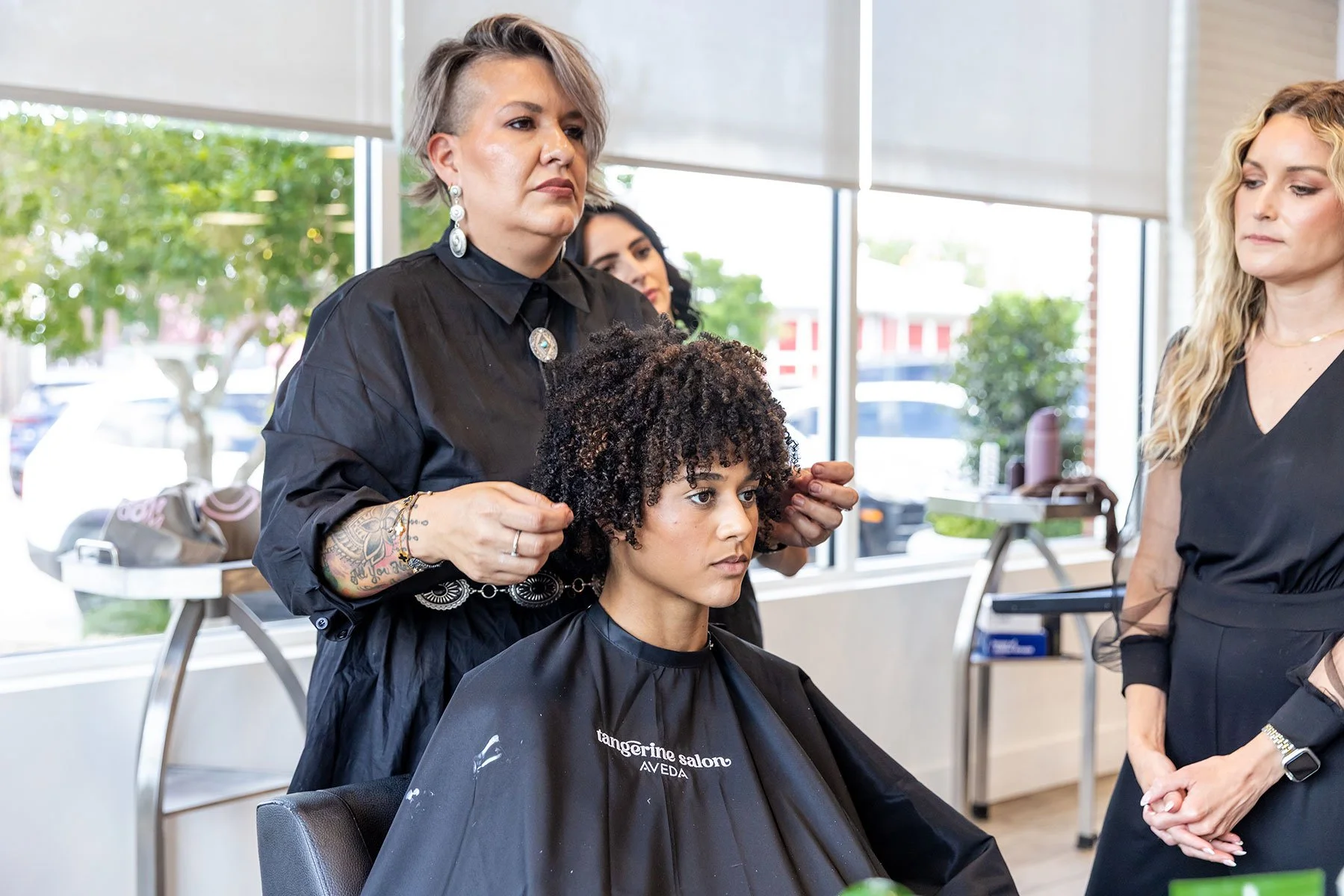
Healthy, defined curls achieved with the Nutriplenish™ routine at Tangerine Salon
Curly Hair and Color: What You Need to Know
Color services and curly hair work beautifully together — but they require more planning and more aftercare than straight hair. Lightening chemically opens the hair's cuticle, which on curly hair can disrupt the natural curl pattern and increase frizz if the hair isn't properly treated before, during, and after the service.
At Tangerine, every balayage and color service on curly hair includes Aveda Botanical Repair™ bonding treatment as a standard part of the appointment. If you're considering a balayage in Dallas, Frisco, or Coppell, your colorist will also advise on a maintenance protocol — typically a Nutriplenish™ Masque once weekly and a gloss refresh every 6–8 weeks — to keep both the color and the curl pattern looking their best.
If your curls have become looser, drier, or less defined after previous color services, that's a sign the hair's protein-moisture balance needs restoring. Our stylists regularly assess this during consultations — it's a straightforward process, and the Nutriplenish line combined with Botanical Repair™ can reverse most of the effects of over-lightened curls within a few treatment sessions. The color maintenance guide has more on what to expect in the weeks following any color service.
Refreshing Curls Between Wash Days
Curly hair generally does better the longer it goes between washes — the natural oils your scalp produces finally get a chance to work down the curl shaft. But day two and three curls need a different kind of attention.
Water is your refresher. Lightly mist your hair with water or a diluted leave-in spray, then scrunch gently. This reactivates any product already in the hair without fully resetting the routine. The Nutriplenish™ Multi-Use Oil, applied as a finishing step, seals the refresh and adds shine without weighing curls down — especially effective on type 3A and 3B hair.
Protect your curls overnight. A satin or silk pillowcase reduces friction that breaks up curl definition and causes frizz. Pineappling — loosely gathering hair at the very top of your head before sleep — keeps the curl shape intact and reduces the flat-spot problem at the back of the head. For tighter coil patterns, protective styles like two-strand twists overnight offer the same benefit. The capsule hair care guide includes overnight care recommendations for every hair type.
Schedule a gloss between color appointments. A standalone gloss or toner appointment at the 6–8 week mark does more for curly hair than just refreshing the tone — the treatment itself adds a layer of sealing shine to the hair shaft, reducing frizz and improving definition. It's a 30-minute appointment that makes a visible difference. Ask about it at your next visit or book it directly online.
Frequently Asked Questions
Can I use Nutriplenish on straight hair?
Yes — Nutriplenish™ was designed for curly and coily hair, but anyone with dry or dehydrated hair benefits from it. If you have straight hair that tends toward dryness, the Light Moisture line works well without adding weight. For straight, fine hair that's already well-moisturized, other Aveda lines like Smooth Infusion or Damage Remedy may be a better fit. Our stylists at all five locations can recommend the right system during your appointment.
How often should curly hair be trimmed?
Every 10–12 weeks is the general guideline, though curly hair can often stretch to 14 weeks between cuts if you're managing split ends well between appointments. Split ends on curly hair travel up the shaft faster than on straight hair because the bends and curves create stress points. The split ends guide covers how to identify damage early and what to do about it. Our Tangerine stylists specialize in dry cutting curly hair — a technique that accounts for how the curl will spring up after the cut, rather than cutting wet and guessing.
Is Nutriplenish safe for extensions?
Yes. Nutriplenish™ is safe for Bellami Professional hair extensions, and the moisture it provides is beneficial for the extension hair, which doesn't receive natural scalp oils at all. The shampoo and conditioner can be used on the full length including extensions. Avoid applying the masque or leave-in directly at the bond or tape attachment point to prevent bond slippage. Our extension specialists will provide specific product guidance at your installation appointment.
Why do my curls look different after every wash?
Inconsistency between wash days usually comes from three variables: the amount of moisture in your hair when you style it, the order of product application, or product buildup that's dulling your curl pattern. The fix is almost always: more moisture at the leave-in stage, consistent product order, and a clarifying wash once a month to remove buildup before returning to the Nutriplenish routine. If you've been through this troubleshooting and still can't find consistency, a curly hair consultation at any Tangerine location is the fastest way to diagnose what's happening.
Can I get volume with curly hair without losing definition?
Yes — and it's one of the most common things our curly clients ask for. The key is root volume, not root lifting after the product is already in. Flip your head upside down while diffusing to build root volume, then flip back and gently scrunch. Avoiding heavy products at the root is also essential — apply the Nutriplenish™ Crème mid-length to ends only, keeping roots clean. For a broader look at volume techniques, the fuller hair guide includes curl-specific tips alongside general volume strategies.
Book a Curly Hair Consultation
Aveda stylists at all five DFW locationsYour Best Curls Start Here
Whether you're building a routine from scratch, troubleshooting frizz, or adding color to your curls — our Aveda stylists will map your curl pattern and create a plan that works with your hair, not against it.
Book Your Consultation